ai income methods ranked: real earnings, real odds
most guides covering ai income methods either bury you in vague ideas with no dollar figures or exist purely to push affiliate links. this one does neither.
what follows is a ranked breakdown of the most viable ai income methods available in 2026, scored on three things: realistic earnings range, time-to-first-dollar, and real failure rate.
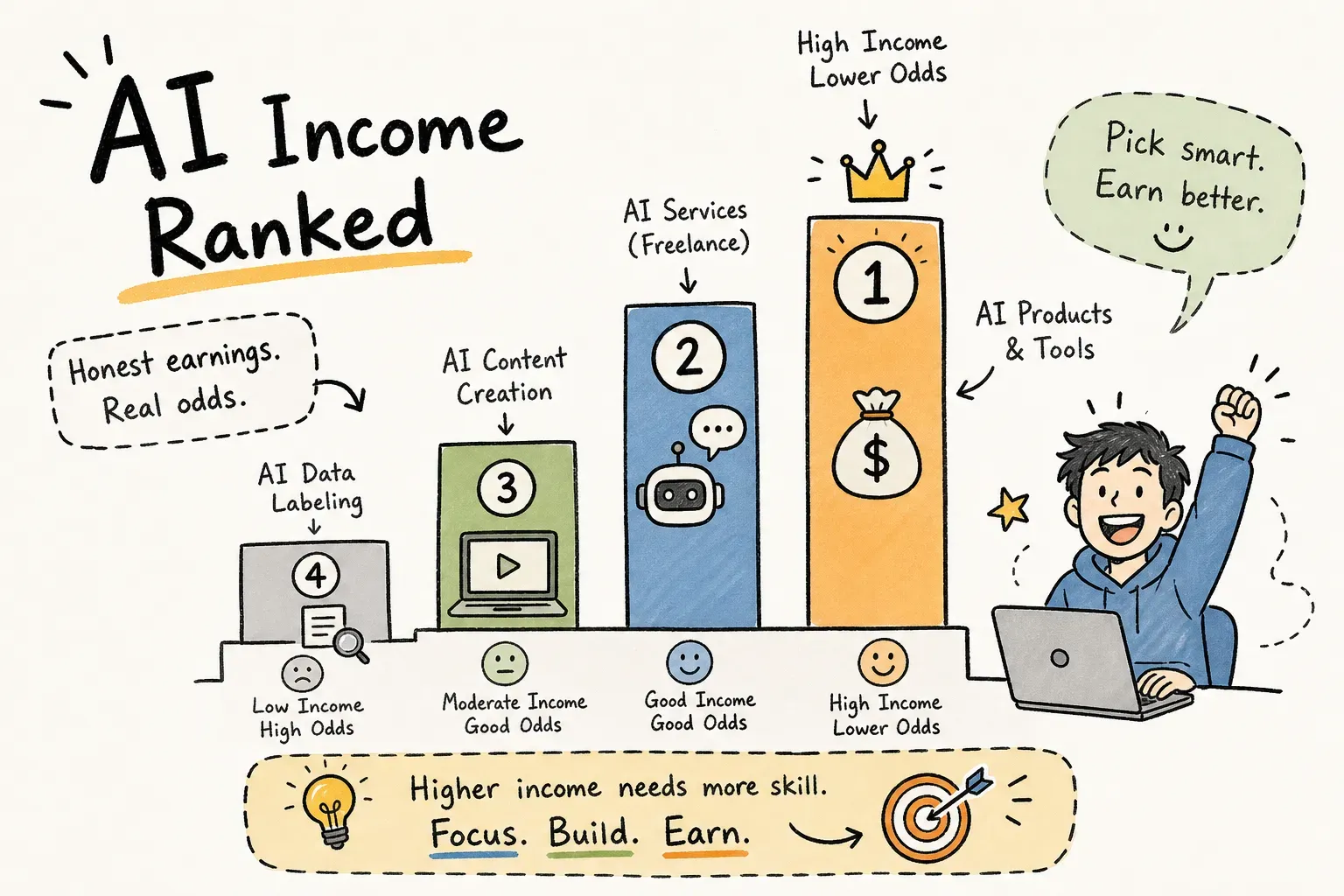
the goal is simple: help you identify three to five methods that match your actual skills and schedule, not whichever one has the flashiest income screenshot on youtube. some of these methods have a real runway.
some are overrun with competition. a few are close to scams dressed up as side hustles.
you'll know which is which by the end.
how these rankings were built
every method in this guide is scored on three numbers: (1) realistic monthly earnings range drawn from published creator reports and case studies, (2) time-to-first-dollar measured in days, weeks, or months, and (3) failure rate, meaning the share of people who start but generate no meaningful income within 90 days. these aren't vanity metrics.
they're the numbers that decide whether a method is worth your actual time.
one caveat: no published, reliable 90-day failure-rate statistics exist specifically for ai side hustles, because most monetized content sites don't publish failure data - they publish success stories. the failure-rate assessments here draw on q1rk's own experiment logs (methods tested from a cold start, documented with real timelines) and observable patterns across public case studies.
they're directional, not precise percentages.
the rankings also reflect 2026-specific conditions. ai tool saturation, market crowding in several categories, and shifting platform rules all affect which methods still have viable entry points.
a method that was wide open in 2024 may now need sharper positioning to work at all. anything that requires an audience you don't have yet, upfront inventory risk, or a pitch deck is flagged plainly.
tier 1: fast ai income methods to your first dollar
these aren't glamorous. but they pay the fastest.
when you're starting out, fast feedback - knowing a method actually converts before you invest months into it - is worth more than a higher ceiling you may never reach.
ai-assisted freelance and service work
this is the clearest beginner entry point into ai income streams: copywriting, social media content, ai-drafted research summaries, and basic virtual assistant services. earnings range from $20 to $150 per hour depending on how specialized you get and which platform you use.
top ai tools for freelancers can help you pick the right stack. upwork and fiverr work, but direct outreach to small businesses tends to convert faster once you have one sample to show.
time-to-first-dollar is days to three weeks if you're actively pitching. the failure rate here is lower than most ai income methods - not because it's easy, but because demand for these services is genuinely high across writing, research, and content categories. the main failure mode is underpricing or not niching down. "ai content writer" is a commodity.
"ai content for saas onboarding emails" is a service someone will pay $100 per hour for. tools needed: chatgpt and claude (free, or about $20/month each) cover the majority of use cases at this tier, though specialty work like image generation or industry-specific data may need extra tools.
content creation and social media support
ai-generated captions, short-form scripts, and repurposed content packages sold to small businesses are real work that real businesses will pay for. monthly earnings range from $100 to $2,000 for consistent service clients, with near-zero startup costs using free tools.
be straight with yourself, though: this category is saturating fast. differentiation now requires a specific niche or industry focus, not just "i use ai to write faster."
data tasks and transcription
this is the lowest ceiling and the lowest barrier. platforms like rev, appen, and scale ai pay in the $8 to $15 per hour range for transcription and labeling work - verify current rates on each platform, as pay varies by task type and volume.
you can see your first dollar within days. treat this as proof-of-concept money - a way to confirm you can follow through on a method and get paid - not a long-term income plan.
tier 2: ai income methods with a real income ceiling
these take longer to land but pay meaningfully more. the skill requirements are higher, which is exactly why there's less competition at the top of each category - most people quit before they get there.
ai chatbot builds and automation freelancing
building no-code chatbots for small businesses, setting up basic automation workflows in tools like zapier or make.com, and selling those as one-time builds or monthly retainers is one of the best value-per-hour opportunities among current ai monetization methods. simple projects run $50 to $200.
ongoing retainer clients typically pay $500 to $2,000 per month for maintenance and updates. tools like botpress and tidio have manageable learning curves; a motivated beginner can usually build a basic working demo in days to a few weeks, depending on the use case.
time-to-first-paying-client is roughly one to three weeks for focused sellers, and up to eight weeks for beginners still building their outreach process. the failure mode here isn't technical. most people who try this stall on the sales side. build your first chatbot for a real business you already have a relationship with, not a cold stranger.
niche content sites and ai-assisted affiliate income
building a topic-specific content site monetized through affiliate commissions or display ads, using ai tools to speed up research and drafting, is one of the more established ai passive income ideas - but the timeline is long. conservative benchmarks from creator reports put beginner-phase earnings at $100 to $500 per month in the first six months, rising to $500 to $1,500 per month once the site gains traction, typically after six to twelve months of consistent publishing.
higher figures are possible in commercially strong niches, but they're the upside case, not the baseline.
the 2026 seo environment adds real headwinds. google's ai overviews have eaten into informational traffic across many categories, and competition from other ai-assisted sites is high. failure rate is high if you pick a commodity topic; lower if you go narrow and add genuine editorial opinion. how to start an ai content business covers the actual build data on what worked and what didn't across several test sites started from scratch.
digital products and ai-generated template bundles
notion templates, canva packs, prompt libraries, and ebook bundles sold on gumroad or a self-hosted store can generate $500 to $3,000 per month once a strong product in a proven niche gains traction. individual product sales run $20 to $499.
time-to-first-dollar is two to eight weeks if you already have distribution. from a cold start with no audience, it's considerably longer.
the real risk here is that the "passive income" framing is misleading. distribution is the hard part, not the product itself.

tier 3: high-upside ai income methods that take longer to build
these have the highest earning ceiling and the longest runway - the highest skill floor, and the highest risk of stalling before you see a dollar. if you already have a professional network or a technical background, the calculus changes.
if you don't, start in tier 1 first.
ai automation agencies and high-ticket service businesses
positioning yourself as an ai implementation consultant for small businesses - building recurring revenue from crm automation, email flows, and customer support systems - is a genuinely viable model for people who can sell. per-project fees run $2,000 to $5,000.
retained clients pay $500 to $2,000 per month. the first client typically takes four to twelve weeks to close and usually needs at least one warm professional relationship to start the conversation.
the note on failure rate: this model works, but most people who attempt it have never sold b2b services before. the ai skills are learnable in a few weeks.
the sales and positioning skills take much longer. if you already have a professional network in any industry, that changes the math significantly in your favor.
micro saas tools and owned digital assets
building small, narrowly scoped software tools using ai apis and no-code or low-code builders, then selling subscriptions or lifetime licenses, has an earnings range of $100 to $5,000-plus per month for successful products. this is for indie builders, developers, or people with a specific workflow problem they understand deeply.
a companion guide on best ai tools for side hustles helps with tool selection, and ai agent tools for solo builders covers the build side for readers who want the technical breakdown.
the failure rates most guides never mention
no precise 90-day failure rate exists in published data for ai side hustles, because most monetized content sites don't publish failure rates - they publish success stories. across public case studies, the pattern is consistent: the biggest hurdle for beginners is usually psychological or strategic, not technical.
common failure modes, across all tiers:
- no niche focus - competing on price instead of clarity
- switching methods every three weeks before any method has time to work
- mismatched time expectations - starting an affiliate site expecting income in 30 days
- relying on cold outreach through platforms without any proof of work
- underestimating how crowded beginner-facing categories have become in 2026
the switching problem is underrated. most people who fail at ai income methods don't fail because the method doesn't work.
they fail because they try one method for three weeks, don't see results, and pivot to the next thing they saw in a newsletter. the method never had time to prove itself.
copyright basics us creators must know
purely ai-generated content - text, images, or audio without meaningful human creative input - cannot be copyrighted in the united states. the u.s. copyright office's position is clear: copyright requires human authorship, and a prompt alone doesn't qualify. if you want to own what you create, add a genuine human editorial layer.
before selling any ai output commercially, verify your specific tool's terms - most major paid plans generally allow commercial use, but the plan tier matters and terms change. chatgpt, claude, and midjourney each publish their commercial-use policies, so check the current version for your plan rather than relying on a summary.
two specific traps worth knowing: ai-generated audio on youtube can trigger content id claims, and ai images imitating specific artists or brands can create trademark exposure. most beginner-to-intermediate methods operate comfortably within allowed use as long as you add human creative contribution and verify tool terms before launching.
how to choose the right ai income method for your situation
the self-assessment is short. how many hours per week can you realistically invest?
do you have any existing skills in writing, customer service, or basic tech? do you need income in 30 days, or can you commit to a six-month build?
your answers narrow the list fast.
direct pairings that reflect real conditions in 2026:
- need income in under 30 days: ai-assisted freelance services or basic data tasks, not affiliate sites
- can invest ten hours per week for six-plus months and you can write: a niche content site is worth the timeline
- have a b2b professional background: ai automation services have the highest per-hour value of anything on this list
- technical background or product instincts: micro saas or automation freelancing
own the asset you're building, whether that's a skill, a client base, or a site. ai income methods built on rented platforms - instagram pages, marketplace stores - are more fragile than owned assets. the q1rk philosophy is grounded in this: notice the shift, build something you own, and don't mistake a platform's algorithm for a business model. the longer version is own the asset, not the account.
your first step this week is not to compare tools for seven days. pick one method.
spend two hours building a minimal version or sending one pitch. the three cheapest, fastest starting points for someone with zero existing audience: ai-assisted freelance pitching, a chatbot build for a local business you already know, or a content site on a topic you already understand well.
start there.
the bottom line
ai income methods in 2026 are generally more accessible than in prior years, going by creator reports and the expanding availability of low-cost tools and templates. accessible doesn't mean automatic.
every method on this list requires real time investment, realistic expectations, and a tolerance for slow starts. the advantage of ai tools isn't that they let you skip the hard parts.
it's that they compress the execution time - many creators report finishing in a few hours what previously took a full day - which matters most once you've picked a direction and actually committed to it.
the people who build real income from this are the ones who pick a method, ship something imperfect, and iterate. not the ones who spend three months comparing options.
if you want the realistic odds and timelines behind any of these, how to make money online in 2026 and how to make money with ai go deeper on the numbers.

faq
which ai income method is fastest to a first dollar?
ai-assisted freelance and service work - copywriting, content, research summaries, basic va tasks. with active pitching, time-to-first-dollar is days to three weeks, because demand already exists and you don't need an audience.
which ai income method pays the most?
ai automation agencies and micro saas have the highest ceilings ($2,000-$5,000 per project or $100-$5,000-plus per month), but they also have the longest runway and highest skill floor. they reward an existing network or technical background; otherwise start in tier 1.
why do most people fail at ai income methods?
not the method - the switching. most quit one method after three weeks and jump to the next, so nothing gets time to work.
picking commodity niches, underpricing, and expecting income in 30 days are the other common failure modes.